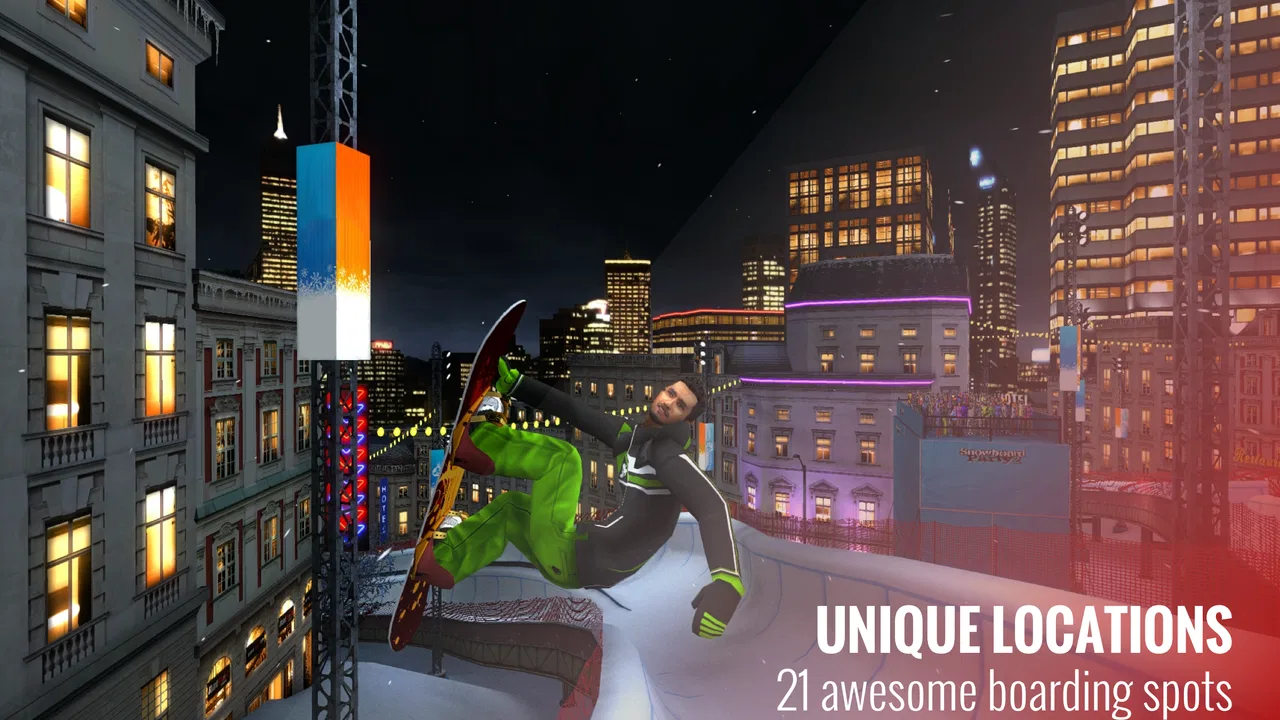
Snowboard Party World Tour Pro
- 4.4
- Rating
- 50.00K
- Installs
- $4.99
- Price

 Analysis by App-foxy
I spent my first sessions with Snowboard Party World Tour Pro expecting a quick arcade distraction, and that is exactly where it makes its strongest first impression. It puts me on a snowboard and asks me to chase the satisfying parts of freestyle riding: landing tricks, building momentum, and making a run look cleaner than the one before it. The controls are approachable enough to understand quickly, but the timing needed for a good landing gives the game more depth than a simple button-mashing sports title.
This is a paid sports game from Maple Media, listed at $4.99, with optional in-app purchases ranging from $0.99 to $69.99 per item. That combination matters because the upfront price makes the game feel more like a complete purchase, while the extra purchase options may still influence how some players approach progression. I would not recommend buying it blindly if you dislike any form of optional spending, but the base experience is easier to take seriously than a game that depends entirely on a free download and constant prompts.
From an exciting first week to a more selective long-term habit
I found that the game’s appeal can shift once the easy excitement of learning its runs gives way to deciding what deserves another session. A small, personal target can make returning feel worthwhile without turning play into a chore; next, I’d weigh how that kind of progress interacts with the paid entry price and optional purchases.
You May Also Like

 Blood Strike: 2.5 Anniversary
Blood Strike’s Loadouts Turn Every Drop Into a Tactical Gamble
A close look at Blood Strike’s custom loadouts: how fast access to signature weapons reshapes its battle royale rhythm, rewards preparation, and narrows the gap between fights.

 Pandora - Music & Podcasts
Pandora’s Music Is Easy to Start, but Harder to Recover
Pandora’s strength is its low-effort path from a seed to a station. Its weak spot is how much confidence it asks you to place in connection, setup, and quiet recovery.

 8 Ball Pool
 Is Built on Rivalries, Rematches, and Routine
A close look at the rivalries, rematches, shared routines, and unanswered safety questions that turn a quick pool match into a persistent mobile community.

 Samsung Music
’s Quiet Strength Is Playing What You Already Own
Its reach comes less from spectacle than from dependable access to a personal library. That simplicity is both the app’s strongest retention engine and its ceiling.

 AccuWeather: Weather Radar
AccuWeather Review: A Quick, Clear Forecast for Everyday Decisions
For everyday plans, the best forecast is the one you can understand quickly. AccuWeather makes rain timing, radar, and local conditions easy to act on, with a few trade-offs.

 Hill Climb Racing
Why Hill Climb Racing Still Turns Crashes Into One More Run
A tiny car, a bumpy hill and one more upgrade: Hill Climb Racing keeps resurfacing because its simple chaos makes every near-miss feel personal.
More From Our News Desk



Why the opening sessions work so well
The first week is where the game earns its place on my device. Snowboarding naturally creates short, repeatable attempts: I can start a run, try a trick, make a mistake, and immediately want another chance. That loop suits a phone or tablet much better than a long match that demands uninterrupted attention. A few minutes are enough for a meaningful attempt, while a longer session gives me room to experiment with combinations and improve my timing.
The appeal is not only speed. Freestyle snowboarding has a pleasing risk-and-reward rhythm. I want to push a jump further, add another movement, or hold a trick a little longer, but every extra decision can make the landing less reliable. The game turns that tension into its main source of fun. A safe run may be useful for learning, yet a successful ambitious run feels much more rewarding because I know I created the result rather than simply completing a route.
I also found that the different event styles give the early experience a useful change of pace. Freestyle encourages creativity and chaining actions, halfpipe riding focuses more on rhythm and repeated aerial opportunities, and big-air challenges make each jump feel like a concentrated test. These are not interchangeable activities. If I was tired of trying to build a stylish sequence, a more focused jump gave me a different reason to replay.
The age rating is Everyone, which makes the presentation broadly accessible. Still, “accessible” does not mean every player will enjoy it equally. Someone looking for a realistic snowboarding simulation may find the arcade handling too forgiving or too game-like. I see it as a pick-up-and-play interpretation of the sport, designed around spectacle and repeat attempts rather than technical equipment setup or authentic resort management.
The control lesson that changed my results
My most useful early adjustment was to stop treating every jump as an invitation to perform the biggest possible trick. At first, I tried to fill each opportunity with movement, and that produced spectacular failures as often as successful landings. A better approach was to learn one reliable sequence first, then add complexity only when I could finish it consistently. That makes the game feel less random and turns improvement into a practical process.
I recommend spending the first sessions learning the relationship between approach speed, launch timing, midair input, and landing preparation. The game becomes noticeably more enjoyable once I stop reacting frantically and start planning a run in stages. Even without chasing a leaderboard, this creates a small personal training routine: repeat a familiar attempt, identify the exact moment it went wrong, and change one input rather than everything at once.
That habit is especially useful for players who normally abandon mobile sports games after a few failed attempts. Here, failure can be informative if I pay attention to whether I mistimed the takeoff, overcommitted during the trick, or failed to prepare for the landing. The game does not need to become a serious simulator for this learning loop to feel satisfying.
What makes it useful in an everyday schedule
A realistic use case is a short break during a commute, between errands, or while waiting for an appointment. I can play one or two runs without needing to remember a complicated story or coordinate with other people. That independence is one of its strongest advantages. It is also a good fit for someone who wants a sports game that can be paused mentally between attempts, rather than one that punishes stepping away in the middle of a match.
On the other hand, I would not choose it as my main game for a long evening if I wanted a constantly changing experience. The core pleasure comes from refining familiar actions, so the first few sessions feel more varied than later ones. Players who need new characters, dramatic narrative turns, or a large social layer may reach the limits of the format sooner.
How it compares with familiar sports alternatives
Compared with a traditional racing game, this feels less about maintaining a perfect line and more about making deliberate moments count. Compared with team sports games, it avoids waiting for opponents, managing many players, or learning a large rule set. That makes it more immediate, but also narrower. I get a focused snowboarding fantasy rather than a broad sports package.
It is also different from a realistic winter-sports simulation. A simulation usually rewards knowledge of equipment, terrain, and technical conditions; this game rewards timing, experimentation, and stylish execution. If I want to feel like I am managing a real athlete’s career, I would look elsewhere. If I want to perform a dramatic run during a short break, the arcade approach is the better match.
Where the novelty begins to thin out
After the initial excitement, the question changes from “Is this fun?” to “What will make me return next week?” The answer is personal improvement. If I enjoy chasing cleaner landings and more ambitious combinations, the game has a reason to stay installed. If I only wanted to see the basic trick possibilities once, the novelty can fade quickly because the central action remains familiar.
That distinction is important before paying. The price is modest enough to make experimentation reasonable, but it still deserves a clear expectation: this is a focused sports game, not an endless content platform. Its lasting value depends more on whether I enjoy mastery than on whether I expect a constant stream of new activities.
The month-to-month value of short mastery goals
For month-to-month use, I found it more helpful to set small goals than to play without direction. One week I might focus on landing a particular kind of sequence reliably. Another week I might try to improve the consistency of my halfpipe runs or make big-air attempts less reckless. These goals create a reason to return without pretending that every session will feel completely new.
This is one of the game’s less obvious strengths: it supports a personal practice loop even when I am not competing against anyone else. I can remember the mistake that usually ends a run and use the next session to address only that weakness. That approach makes short play sessions feel connected. Without it, I tend to repeat the same comfortable actions and then wonder why the game feels stale.
I would advise keeping the challenge narrow. Trying to improve tricks, speed, landings, and every event type at once makes progress difficult to notice. A better workflow is to choose one event style, use a conservative approach until the basic movement feels automatic, and then add one riskier action. This is not an official training plan; it is simply the method that made my own sessions more rewarding.
What the paid model means over time
The listed price of $4.99 changes how I judge the game’s long-term value. I expect a paid title to let me enjoy its central loop without treating every attempt as a sales opportunity. The presence of optional purchases between $0.99 and $69.99 per item means I would still keep an eye on how progression feels and avoid spending impulsively just to solve a temporary frustration.
My practical advice is to decide before playing whether you are comfortable treating the purchase options as irrelevant. If you can do that, the game is easier to evaluate on its controls and replay value. If you know that locked progress or tempting upgrades will bother you, the extra purchase range may become a source of friction even though the game has a paid entry price.
This is also where it differs from many free sports alternatives. A free game may be easier to try, but it often asks for more patience with interruptions or monetization pressure. Here, the initial payment gives the experience a clearer identity, yet it does not remove the need to think about optional spending. I prefer that transparency over pretending the two models are identical.
The maintenance burden is low, but the habit needs direction
There is little routine maintenance in the usual sense. I do not need to manage a roster, check in every day, or maintain a complicated collection simply to enjoy a run. The game’s main upkeep is mental: remembering what I am practicing and resisting the urge to play every attempt in exactly the same way.
That low burden makes it suitable for a device where I want a dependable offline-style break from more demanding games, though I would not assume every technical behavior on every device is identical. The listed minimum operating system is Android 6.0, and the current version is 1.5.2.RC. Those details suggest broad compatibility for many older Android devices, but performance can still depend on the individual phone or tablet.
For a smoother routine, I would play with a simple intention rather than opening it automatically. Before a session, decide whether the goal is learning, experimenting, or simply relaxing. If I am practicing, I replay a manageable challenge. If I am relaxing, I stop trying to force a perfect score. This small distinction prevents the game from turning every short break into a frustrating test.
The main sources of fatigue
The biggest source of fatigue is repetition without a personal target. The controls may remain enjoyable, but the emotional payoff drops when every run uses the same safe pattern. I also noticed that failed attempts can feel more irritating when I cannot immediately identify which part of the sequence caused the problem. That is why changing one input at a time is more useful than restarting with a completely different strategy.
Another limitation is the narrow fantasy. The game gives me snowboarding action, not a wider winter-sports world. There is no reason to expect it to satisfy someone who wants skiing, skating, team competition, or a deep career structure. Its specialization is a strength during a focused session and a weakness when I want variety.
The paid-plus-purchases structure can add a second kind of fatigue. Even if I never buy anything extra, the knowledge that items can cost as much as $69.99 may make me more cautious about progression and value. I would skip this game if that arrangement makes you uncomfortable on principle. A simpler one-time-purchase title would be a better fit for a player who wants no optional spending layer at all.
Who should install it, and who should skip it
I would recommend it to players who like arcade sports, short sessions, and the feeling of improving a repeated technique. It is particularly suitable for someone who enjoys trying a trick, failing, adjusting timing, and eventually landing a cleaner version. It also works for casual players who want a snowboarding game without learning a complicated management system.
I would suggest skipping it if your priority is realism, extensive storytelling, online social competition, or a constantly expanding set of activities. I would also be cautious if you dislike replaying familiar challenges. The game’s value is tied to repetition with purpose, not endless novelty.
Its 4.4 average from around 1.4 thousand ratings and more than 50 thousand installs indicate that it has found an audience, but those figures should not replace your own preference test. The important question is whether you enjoy the act of refining a run. A strong rating cannot make a focused arcade loop appealing to someone who wants a broader sports simulation.
My long-term verdict
After the first-week excitement fades, I still see a reason to keep this game installed, but only for the right kind of player. Its lasting value comes from compact sessions, recognizable event styles, and the satisfying difference between an uncontrolled attempt and a deliberate one. I like that I can return after a gap and understand the basic objective immediately, then choose whether to practice or simply make a few runs.
It does not completely escape the usual problems of mobile sports games. Repetition can expose the limited scope, failed landings can become tiring, and optional purchases complicate the value of an already paid product. Those are meaningful reservations, not minor footnotes. They are also why I would not call it an automatic recommendation for everyone.
For me, the game earns lasting space when I treat it as a focused skill toy rather than a permanent source of new content. I would keep it for short breaks, especially when I want something active but not mentally heavy. The best way to get value from it is to set a small technique goal, play a handful of purposeful attempts, and stop before repetition becomes frustration.
My final recommendation is simple: choose it if the idea of mastering arcade snowboarding sounds more appealing than collecting endless content. The Everyone rating, broad Android support from version 6.0 onward, and compact event structure make it approachable, while the $4.99 price gives the game a clear starting point. Just remember that its long-term appeal depends on your willingness to practice, not on constant novelty. For a player who enjoys that trade-off, Maple Media’s snowboarder has enough character to remain a useful little sports game well beyond the first few sessions.
FAQs for Snowboard Party World Tour Pro
01What is Snowboard Party: World Tour Pro?
Snowboard Party: World Tour Pro is a snowboarding game for Android and iOS that lets you ride through different mountain courses, perform tricks, complete challenges, and compete for high scores. It combines arcade-style controls with progression features, including unlockable boards, riders, and upgrades. The Pro edition is designed for players who want the full experience with fewer restrictions than the standard version.
02Is Snowboard Party: World Tour Pro suitable for beginners?
Yes, beginners can start playing without needing previous experience with snowboarding games. The game includes relatively simple touch controls, and the early events provide a useful introduction to movement, jumps, grabs, and other tricks. However, mastering advanced combinations and landing difficult stunts takes practice. New players should begin with basic runs before attempting the more demanding challenges and high-score objectives.
03Does Snowboard Party: World Tour Pro work offline?
Many of the core snowboarding activities can generally be enjoyed without a constant internet connection, which is convenient for playing while traveling or when mobile data is unavailable. Nevertheless, some functions may require internet access, such as advertisements, purchases, account-related features, updates, or online leaderboards. It is best to launch the game online after installation and check which content remains available offline on your device.
04Does the game include in-app purchases or advertisements?
The Pro version is intended to offer a more complete and less interrupted experience than a typical free edition, but availability of advertisements, optional purchases, and pricing can depend on the platform and current store release. Before downloading, review the Google Play or App Store listing for the latest details. Players should also check the device’s purchase settings if children will be using the game.
05What devices are recommended for Snowboard Party: World Tour Pro?
The game should run on many relatively modern Android and iOS devices, but performance can vary according to the phone or tablet’s processor, graphics hardware, operating-system version, and available storage. Older devices may experience slower loading, reduced visual quality, or occasional frame-rate drops. Make sure you have enough free space for the installation and keep the operating system updated for the best possible experience.
Pros
- Responsive controls make carving and landing tricks feel satisfying.
- Wide range of boards and gear allows for meaningful customization.
- Different locations provide visual variety and fresh riding challenges.
- Progression system gives regular goals beyond simply completing runs.
- Offline play is useful when you do not have a reliable internet connection.
Cons
- Some advanced equipment and content may require substantial grinding.
- Trick-heavy events can feel difficult until the controls become familiar.
- Visual quality varies between newer and older mobile devices.
- Longer sessions may drain battery noticeably on some phones.
- The game may feel repetitive if you prefer modes beyond downhill riding.

Snowboard Party World Tour Pro
Gallery